As an Italian-American local, I’ve spent my time here investigating all those little out-of-the-way towns around Venice. I’m here to tell you about the 5 best places for a day trip from Venice, all within a 2-hour train or car ride.
Venice, Italy is one of the most popular tourist destinations in Italy, if not all of Europe. And it’s not hard to see why: great food, unique location (there’s water on the streets!), and it’s all easily walkable (if you don’t mind stairs).
But what if you want to get outside Venice for a day and get away from all the other tourists?
Keep reading to see my picks for the 5 best towns worth the day trip from Venice!
Padova (Padua)
The closest and most well-known town on this list is Padua, or Padova in Italian. It’s less than an hour away, and easy to walk around, making it the perfect day trip from Venice.
Mercato il Sotto Salone
I highly recommend visiting the Mercato il Sotto Salone. It’s the oldest covered market in Europe, and it’s great to wander the food halls and see the vendors selling all types of food. Make sure you pay attention to the schedule, though – most of the vendors are only opening in the morning, from about 9AM to 1PM. Some will reopen in the afternoon around 4, but to get the real immersive experience, get there before lunch.
Above the mercato is Il Salone, which used to house the courts for the city of Padova. Now they host concerts and art shows, but the real draw are the hundreds of frescoes on the upside down ship-shaped walls, and the giant (and I mean giant!) horse at the far end.
The frescoes date back to the early 15th century and are split into two sections: the upper area, which shows each month of the year and the zodiac signs, and the lower section, which was painted to align with the function of the hall as a place of government.
The Basilicas

Basilica of Saint Anthony
The city also has two basilicas, the Basilica of Saint Anthony and the Basilica of Mary of Padua. Originally constructed in the 13th century, the Basilica of Saint Anthony features a mishmash of architectural styles outside, but inside it houses not one, but three museums. That’s how giant this church is. Even if you’re not religious or Christian, it’s definitely worth looking inside these basilicas to see the beautiful renaissance artwork and all the smaller chapels, including the magnificent great altar.
Magnificent as Anthony’s basilica may be, the Basilica of Saint Mary of Padua, usually shorted to Padua Cathedral, is actually the official seat of the bishop of Padua. While the Padua Cathedral is equally as imposing physically, the decor is much more muted and elegant. The basilica has been reconstructed multiple times, most recently after a bomb hit part of the facade in World War I. Much of the decoration is still unfinished.
Padova is also great for simply wandering the streets and seeing the sights. There’s the Piazza dei Signori, with its intricate clock tower (no Doc Brown to be seen the day I was there, though. Probably for the best), the Jewish Ghetto area, including the Sinagoga Italiana di Padova (Italian Synagogue of Padua), restored after World War II and now housing the Jewish Heritage Museum of Padua.
The largest city on this list, Padova is a great option if you only have a few hours to escape with a day trip from Venice. It is still a little touristy and likely to be a little crowded, but an enjoyable Italian destination.
Bassano del Grappa
This town is a bit further away from Venice, but worth the hour-ish train ride or car ride, and definitely big enough to be an entire day trip from Venice on its own. It’s a medium sized town that is wonderfully walkable, though a bit more hilly than Padova. Inside the town walls are cute little shops, book stores, and a twice-weekly market, on Thursdays and Saturdays.

Piazza Libertà in Bassano del Grappa
If the name sounds familiar, it’s because it’s the birthplace of grappa, a fragrant grape-based brandy, made from the leftovers of winemaking. You can check out the Poli Grappa Museum to learn all about the history and making of grappa, do a tasting, and buy your own bottle of grappa to take home.
Near the museum is the Ponte Vecchio, a wooden covered bridge spanning the river Brenta. It offers beautiful views of the Dolomite mountains, where the river originates, and is great for that very Italian wooden covered bridge picture. The bridge has been destroyed and rebuilt multiple times since it’s first construction in the 13th century, including by war, floods, and fire, and the latest incarnation was built in 1948, with partial reconstruction and stabilization happening multiple times between then and present-day.

Ponte Vecchio in Bassano del Grappa
At the far end of the bridge is the Museo del Ponte degli Alpini, if you want to learn more about this oft-reconstructed bridge.
As an American who eats at ‘weird’ times by Italian standards, I highly recommend the Birreria Lowen at the far end of the Ponte Vecchio. It is open for food service all day long (rare in Italy, where most place close after lunch and don’t reopen until 7:30 or 8 for dinner) and the combination of the beautiful outdoor dining area, delicious bruschetta (pronounced “brue-sket-ta” in Italian), and a nice cold beer are wonderful after walking around in the hot, Italian summer sun.
Tip from a local
Check out Libreria Palazzo Roberti, on Via Jacopo da Ponte. Even if you’re not really interested in buying books on your vacation, it’s worth taking a wander through to see the architecture of the multi-story palazzo inside. They regularly host events such as photography exhibits, author presentations, and concerts. And they even have a small English section!
Marostica
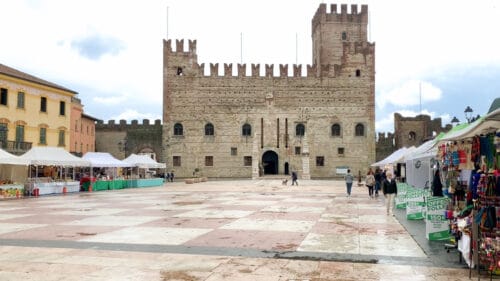
The Lower Castle in Marostica
Venturing a little further afield to an even smaller town, Marostica is picturesque and quintessential Italy. It also hosts a weekly market, much smaller than the one in Bassano del Grappa, and has several cafes (bars in Italy), a wonderful gelateria, and beautiful architecture dating from the 13th century, including a drawbridge and a moat! It’s a picturesque day trip from Venice.
The real claim to fame for Marostica is their extremely well-known, popular Live Chess Game. For one weekend in September, actors take over the square in Marostica and play out a live-action chess game. Spectators watch from stands as the actors, dressed as their board pieces, replicate a chess game played in 1454 to win the hand of the fair Lionara.
Issues of modern feminism aside, the game was proposed by Lionara’s father as a way to avoid either of the two champions vying for her hand to be lost in a duel. The defeated warrior would marry her sister, Oldrada.
How fun for her to be the consolation prize.
Anyway, the father of these two lucky ladies decided to make a big festival out of the event, and invited local lords and nobles from nearby to come and watch, and he added dancers and singers and all sorts of festivities.
Now the event is repeated every other year (even-numbered before Covid), where over 500 performers get together for the first weekend in September to replicate this chess game and try to win the hand of the fair Lionara.
If you don’t come during the chess game, you can tour the lower castle and see all the costumes on display, tour the exhibition rooms, see the council room, and walk through the Hall of Arms.
Tip from a local
Venture outside the city center to Pasticceria Chiurato for the most amazing pastries and candies in Marostica. Don’t look at their Instagram if you don’t want your mouth to immediately start watering. You’ve been warned.
Cittadella and Castelfranco
I’m cheating a little by giving you two towns in one, but they’re both so small I need to double up.
Cittadella

Castelfranco Town Gate
Visiting Cittadella (pronounced chi-ta-del-la) is like going back in time. It’s an hour and a half away from Venice by a combination of train and bus, but it looks like something out of a history book. It’s a medieval walled city that still has a moat surrounding it, and it’s one of the few surviving towns with almost all of its wall intact.
There are four entrance gates roughly corresponding to the compass directions and it’s easily walkable inside the city walls. You can visit the Tower of Malta (Torre di Malta, in Italian), which was built as a prison in 1251, and it houses the Civic Archeological Museum, with artifacts from the Bronze Age through the Renaissance. The history of the Tower of Malta was much less pleasant, with it having such a terrible reputation that Dante even mentioned it in the Divine Comedy.
If that isn’t your jam, you can also walk the walkway on top of the city walls and get an amazing view of the city below and beyond the walls.
Castelfranco
Castelfranco is the sister town to Cittadella. It also boasts an impressive city wall, with one side almost entire intact, and moat. Castelfranco is walkable both inside the old city and in a few piazzas just outside the wall and moat, most notably the Piazza Giorgione. This piazza hosts the twice-weekly markets on Tuesdays and Fridays, and is surrounded by a shopping arcade filled with cafes, restaurants, and shops.
Inside the town wall, you can visit Il Museo Casa Giorgione, dedicated to hometown favorite, the famous renaissance artist Giorgone. Located in the house that he painted most of his works in, the museum contains over 100 artifacts related to his life in Castelfranco. You can also visit the Palazzo del Monte di Pietà, which now houses the city library.
Tip from a local
If you have limited time, you only really need to see one of these two towns. I recommend Castelfranco, as there’s a bit more to do, both inside the walls and in the Piazza Giorgione.
Asolo
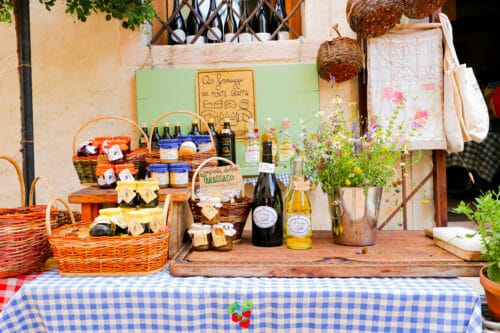
A shop in Asolo
I’ve been saving the best for last. Also, admittedly, the most difficult to reach.
Asolo is a very small town nestled on a hill in the foothills of the Dolomites. While it’s no further away geographically than Bassano del Grappa or Marostica, by public transportation it’s about two and a half hours from Venice, including a bit of a walk up a hill.
There is a shuttle bus that runs from the nearest bus stop to the city center that runs every 30 minutes that you can take instead of walking up the hill, if you prefer. Tickets can be purchased on the bus itself and are timed to be valid for 75 minutes. If you have a car, then it’s much easier and there’s parking right in the center of town (without the walk up the hill).
But if you can make it there, the charm and quaintness of the town is totally worth the effort.
What to See and Do
Nicknamed “The City of the Hundred Horizons” for its mountain views, Asolo is small but rich in Italian experiences. It is believed the town has been inhabited since prehistoric times, and has changed allegiances many times in its long history.
Adjacent to the town square is Museo Civico di Asolo, in the Loggia della Ragione. Originally build to house the town council, it boasts 16th century frescoes on the outside and an amazing collection of artifacts on the inside.
It includes an archaeological section, art gallery, cathedral treasury, and several artifacts of famous Asolo residents.
Nearby is the Rocca di Asolo, a polygon-shaped fortress, with walls an average of 15 meters (50 feet) high! Its perch at the top of Mount Ricco allows for stunning views from the top of the castle walls, but be prepared for a steep walk up to the entrance.
From the main square, you can admire the Villa Scott-Pasini, sit and enjoy an apertivo under the shady trees with the gorgeous views of the valley below, or simply wander the cobblestone streets. Asolo is a wonderful town to stroll along the arcades to discover delightful corners and alleys, with plenty of wonderful shops, bars, and restaurants to meet any budget.
Tip from a local
Wear sturdy walking shoes. Asolo is not the time to show off your fancy new heels or uncomfortable loafers!
Bonus: Chioggia

Chioggia (ki-o-ge-ya) is technically part of Venice and is a 2-hour boat ride away from St. Mark’s Square. An easy day trip from Venice, it’s a seaside town with several paid beach areas that are perfect if you just need a day to relax and unwind. The cute downtown is worth exploring, as is the 14th century fort.
If you’re looking for a beach to relax on, there are dozens along the coastline to choose from.
My personal favorite is Bagni Amarea. It’s smaller and less crowded than some of the options closer to town, but it’s also slightly cheaper, about €6,50 for the day. It also has a much more relaxed vibe. Rental of a beach chair is included in your admission price.
You can also upgrade to an umbrella at the entrance. The beach chairs also have these cool little flip down awnings if you don’t splurge on an umbrella – something I’ve never seen on a lounger before!
There are also bathrooms (though a bit primitive – like much of Italy, it’s bring your own toilet paper!), showers, and a cafe on the beach to have lunch or drinks in the afternoon. The beach itself was clean and not rocky, and there was an ice cream stand a little further away.
In conclusion
If you’re looking to escape the bustle and crowds, these 5 towns are totally worth the day trip from Venice. They can give you a taste of the real Italy, with much fewer crowds. They’re definitely worth the day trip from Venice to visit one or two to see another side of Italian life.